
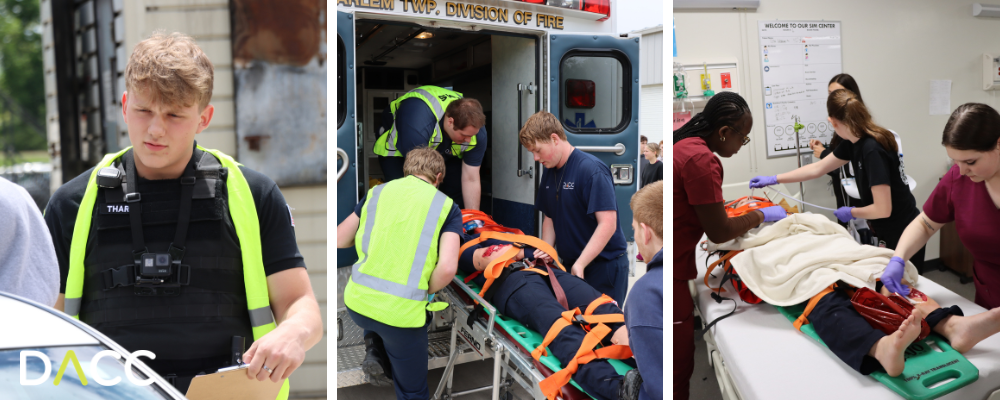
When a traumatic collision involving an impaired driver occurs on a roadway, it takes an entire team of well-trained professionals to ensure the victim of the crash is cared for and the perpetrator is held accountable.
Students from three DACC labs – Fire Service Training, Criminal Justice, and Healthcare Technician – are training to be a part of those teams one day. They got a real-world look at what an experience like that would entail through a collaborative simulation exercise Thursday afternoon.
“The great part about this is, you can job shadow anywhere, and that’s great – but in these kinds of situations, we get to do the work ourselves. We’re not just watching it, we’re actually doing it,” said Audrey Bohman, a senior from Olentangy Liberty in DACC’s Healthcare Technician program.
“This is the kind of thing I could never get from a traditional high school experience. It’s unique to DACC because you’re getting to collaborate and connect with students from different labs, and you’re also doing things that you’ve trained for. You know all the things you need to know for your field, but you’re also actively doing them and practicing what you’re learning.”
 The scenario
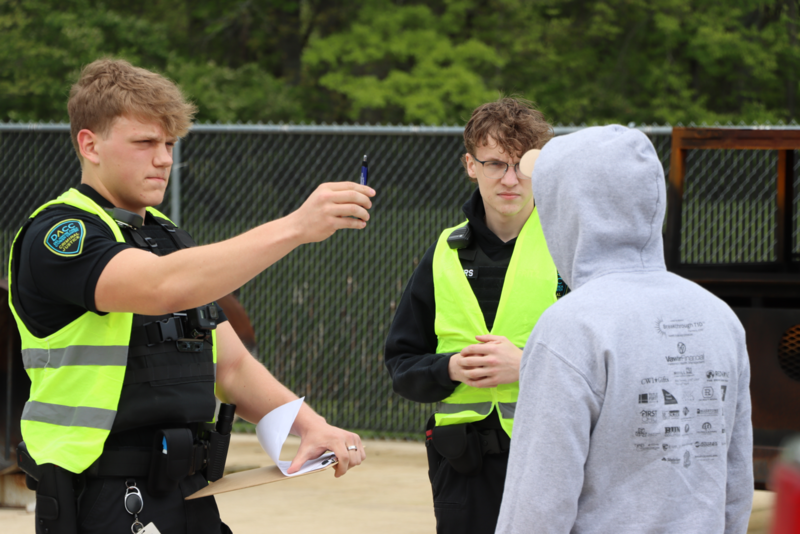
During the simulated emergency response situation Thursday, law enforcement officials (Criminal Justice students), firefighters and EMTs (Fire Service Training students) respond to a 911 call concerning a high-speed collision on a roadway. The driver, who appeared to be impaired upon arrival, had crashed his car into the driver’s side of another vehicle.
Criminal Justice students were responsible for securing and processing the scene – including interviewing witnesses, conducting a field sobriety test on the driver, and collecting evidence, among other obligations – while Fire Service Training students were responsible for extracting the victim from the vehicle, stabilizing the victim and delivering initial medical care, while safely transporting her via ambulance to the hospital.
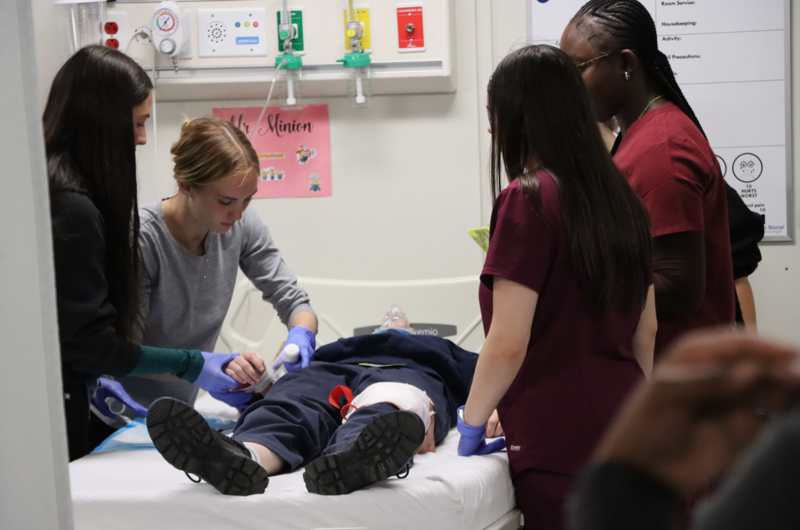
Nurses in the hospital’s Emergency Department (Healthcare Technician students) were responsible for receiving the patient and delivering emergency medical care.
The scenario required quick and informed communication between all three groups, as they worked together to respond to the emergency situation in real-time.
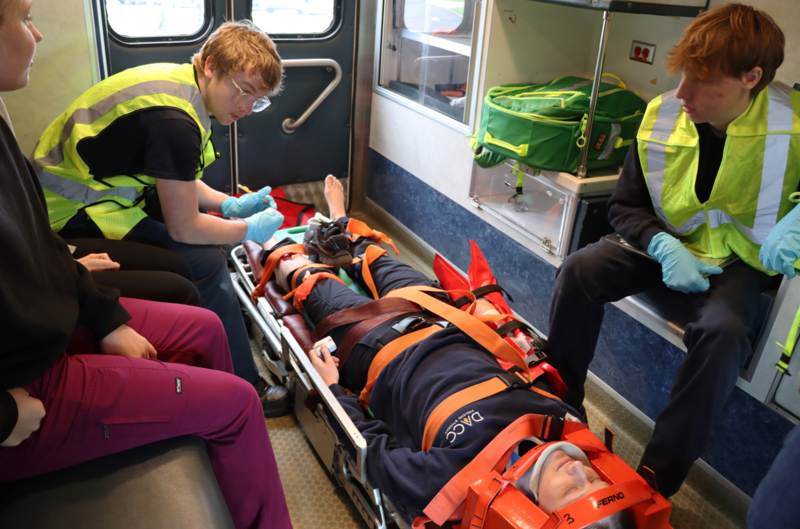
“I think our students got to see it more holistically, everything that’s going on during an event like this,” DACC Fire Service Training Instructor Tim Stainer said. “Instead of us just doing our part, and studying and focusing on what we do, this allowed our students to see how the whole thing works together, by getting to work with each other.”
The impact
The exercise was conducted entirely on DACC’s campus, with the Fire Grounds serving as the site of the mock crash scene and the Healthcare Technician lab serving as the hospital.
DACC instructors and additional industry experts provided real-time coaching and advice to students from all three labs as they navigated the emergency response process.
“It was really cool to see the full process, especially when I was out there doing the field sobriety tests – it’s a lot different than it looks, when you’re trying to get every detail,” said Max Tharp, a senior from Olentangy Berlin in DACC’s Criminal Justice lab. “I thought I did well, but I have a lot to improve on.”
This is the third year that Fire Service Training and Criminal Justice have collaborated on this emergency response exercise. It’s the first year Healthcare Technician has joined, bringing the emergency care process full-circle.
“When they’re out in those job fields, all three of those entities are working closely together all the time,” Stainer said. “The more experience they get in jointly working to solve issues, the better. It just benefits those students in the long run.”
'Like it is in the real world'
Tharp plans to enlist in the U.S. Air Force and serve in the U.S. Air Force Security Forces after graduation, with the goal of one day returning to serve as a police officer. He said Thursday’s exercise provided him with perspective on what his fellow first responders go through during an emergency response situation.
“I had never really seen what EMS does with my own eyes before today. It was cool seeing their whole process and seeing how it moves into nursing,” Tharp said. “It was really cool to see everyone working together, like it is in the real world.”
Seniors from each lab utilized two years of training during Thursday’s exercise. They were able to respond quickly and skillfully to the emergency situation, having completed hundreds of hours of real-world, hands-on learning, both in their DACC labs and out in the field.
Bohman, who plans to enter the Pre-Med track at the University of Tennessee following graduation, listed off more than a dozen skills that she learned in-lab and utilized during the training. She seemed proud of the way her team responded in the moment.
It was two years of learning boiled down into one 911 call.
“I think it was great, getting to collaborate with other labs and see how what they’re doing is a reflection of what we’re doing, and our worlds coincide with one another,” Bohman said. “Working together to get that real-life practice is very different from trying to practice in our lab on our own. It was great to collaborate. We got to see what it's like out in the real world.”